
Sirken: Making Reuse Profitable at Industrial Scale
For nearly a decade, the world has looked to ReTuna in Eskilstuna, Sweden, as proof that reuse can work.
It has been celebrated by the BBC, The Guardian, National Geographic, Al Jazeera, the World Economic Forum and the European Commission as a visionary example of circular economy in practice — a physical marketplace where discarded goods are given a second life. ReTuna proved something critically important: people want reuse, and cities can build infrastructure around it.
But there is a question that has been discussed far too little.
Can reuse actually be profitable — at scale, across industries, without subsidies?
At Sirken, we believe the answer is unequivocally yes.
From Inspiration to Infrastructure
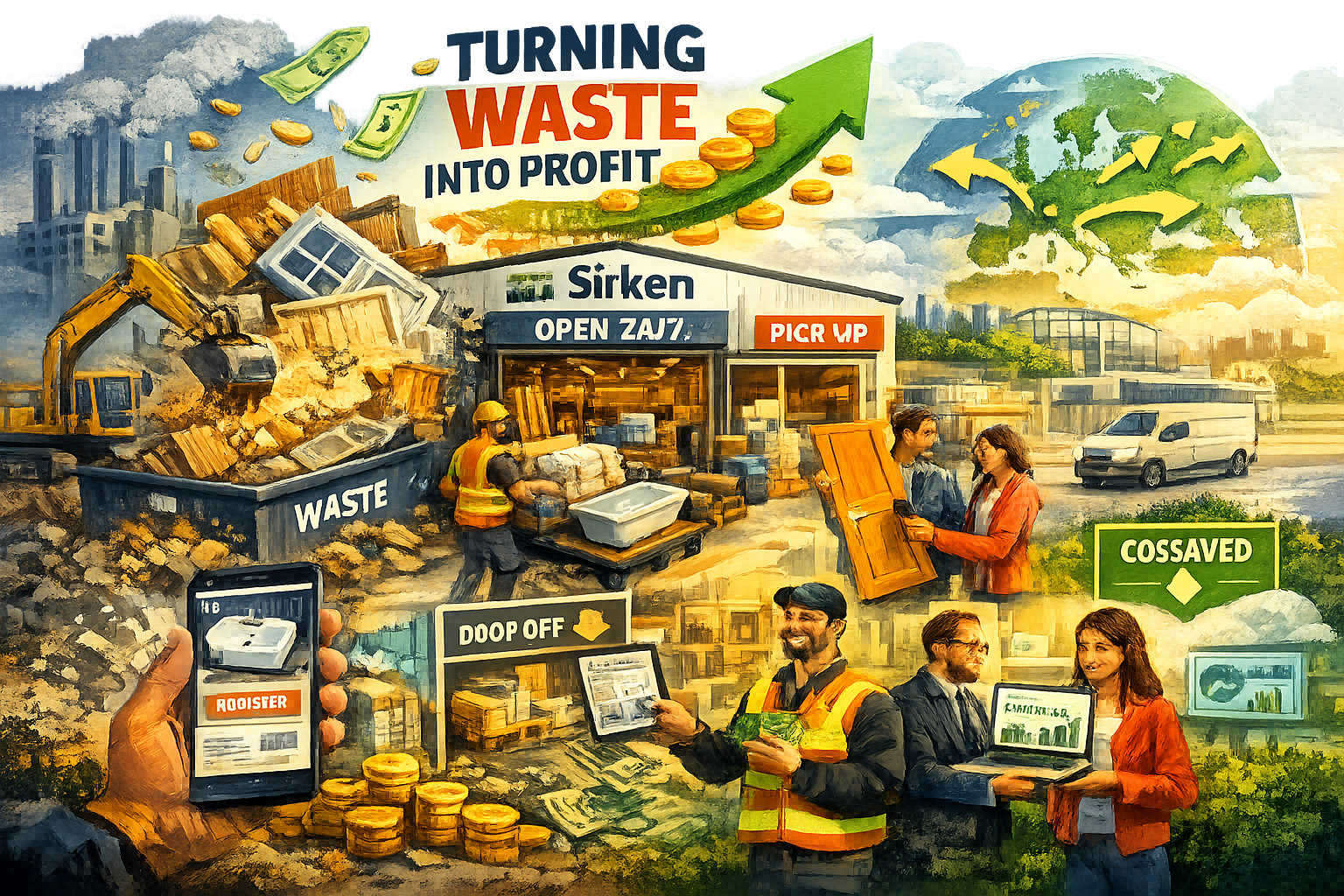
Sirken is a Norwegian company building the missing infrastructure for reuse in the construction and industrial sectors — one of the world’s largest sources of waste, emissions and lost value.
Unlike traditional reuse initiatives that rely heavily on public funding or idealism, Sirken is built on a commercially viable business model:
-
A national and soon international partner network
-
A robust software platform at the core
This is not a charity.
This is not a pilot.
This is not a one-off destination.
This is reuse as a scalable, profitable market.
Why Sirken Works Where Others Struggle
The construction industry alone discards billions of euros worth of unused and reusable materials every year — not because they lack value, but because there is no efficient system to handle them.
Sirken changes that by aligning incentives across the entire value chain:
-
Suppliers and contractors avoid waste costs and earn kickback on materials they would otherwise discard
-
Hub operators earn revenue by managing local reuse logistics
-
Buyers gain access to affordable, high-quality materials
-
Cities and society reduce emissions and material extraction
Every actor benefits economically — not just environmentally.
That alignment is the difference.
Software Is the Game-Changer
Where ReTuna proved the physical concept, Sirken industrializes it through technology.
Sirken’s platform integrates:
-
AI-powered product registration (image recognition, NOBB/product databases)
-
Real-time inventory across decentralized hubs
-
Automated CO₂ and waste savings reporting
-
Digital partner management and revenue sharing
-
Self-service purchasing and access control 24/7
This software-first approach allows Sirken to scale faster, cheaper and across borders — without rebuilding the model from scratch every time.
The Numbers Speak for Themselves
-
~NOK 10 million in annual revenue
-
Break-even operations
-
10,000+ registered users
-
7,000+ products sold
-
20 self-service reuse hubs
-
Strong organic growth with minimal capital deployment
In 2026, Sirken launches a fully new AI-powered platform and expands into four international markets.
Profitability Is the Missing Climate Conversation
Reuse has long been framed as a moral or environmental obligation.
That framing has limited its impact.
The uncomfortable truth is that systems only scale when they are profitable. Sirken addresses the one factor most sustainability discussions avoid: economic reality.
Reuse does not need to compete with the linear economy on ideology.
It needs to outperform it on efficiency.
Sirken is proving that it can.
A Global Opportunity
The challenge Sirken addresses is not uniquely Nordic. Every industrialized country struggles with surplus materials, returns, overproduction and inefficient disposal.
The global market for reused and surplus goods is estimated at USD 1.6 trillion — and growing.
Sirken is building the platform to unlock that value.
An Invitation
ReTuna showed the world what was possible.
Sirken is showing what is scalable.
To policymakers, investors, industry leaders and media across Europe and beyond:
If we are serious about circular economy, climate impact and resource efficiency, then it is time to focus not only on good intentions — but on business models that actually work.
Sirken is one of them.